
PUBLICATIONS AND MEDIA

Simple On-Plastic/Paper Inkjet-Printed Solid-State Ag/AgCl Pseudoreference Electrode - Everson Thiago Santos Gerôncio da Silva , Sandrine Miserere , Lauro Tatsuo Kubota , Arben Merkoçi, Analytical Chemistry, 2014, 86 (21), pp 10531–10534
Annexin-V/quantum dot probes for multimodal apoptosis monitoring in living cells: improving bioanalysis using electrochemistry - Helena Montón , Claudio Parolo , Antonio Aranda-Ramos , Arben Merkoçi , Carme Nogués, Nanoscale, 2015,7, 4097-4104
Graphene Quantum Dots-based Photoluminescent Sensor: A Multifunctional Composite for Pesticide Detection - Erhan Zor , Eden Morales-Narváez , Alejandro Zamora-Gálvez , Haluk Bingol , Mustafa Ersoz , Arben Merkoçi, ACS Appl. Mater. Interfaces, 2015, 7 (36), pp 20272–20279
On-the-Spot Immobilization of Quantum Dots, Graphene Oxide, and Proteins via Hydrophobins - Alfredo M. Gravagnuolo , Eden Morales-Narváez , Charlene Regina Santos Matos , Sara Longobardi , Paola Giardina , Arben Merkoçi, Advanced Functional Materials, 2015, 25 (38), pp 6084–6092
Molecularly Imprinted Polymer-Decorated Magnetite Nanoparticles for Selective Sulfonamide Detection - Alejandro Zamora-Gálvez , Abdellatif Ait-Lahcen , Luiza A. Mercante , Eden Morales-Narváez , Aziz Amine , Arben Merkoçi, Anal. Chem., 2016, 88 (7), pp 3578–3584
Graphene-based Janus micromotors for the dynamic removal of pollutants - Jahir Orozco , Luiza A. Mercante , Roberto Pol , Arben Merkoçi, J. Mater. Chem. A, 2016,4, 3371-3378
Nanochannels for electrical biosensing - Alfredo de la Escosura-Muñiz , Arben Merkoçi, TrAC Trends in Analytical Chemistry, 2016, 79, pp 134–150
Water Activated Graphene Oxide Transfer Using Wax Printed Membranes for Fast Patterning of a Touch Sensitive Device - Luis Baptista-Pires , Carmen C. Mayorga-Martínez , Mariana Medina-Sánchez , Helena Montón , Arben Merkoçi, ACS Nano, 2016, 10 (1), pp 853–860
Towards integrated detection and graphene-based removal of contaminants in lab-on-a-chip platform - Chałupniak, A., Merkoçi, A., A. Nano Res., 2017, pp 1-15
Investigation of sulfonamides inhibition of carbonic anhydrase enzyme using multiphotometric and electrochemical techniques - Bourais, I., Maliki, S., Mohammadi, H., Amine, A., Enzyme and Microbial Technology 96, September 2016, pp 23-29
Voltammetric determination of sulfonamides using paste electrodes based on various carbon nanomaterials - Ait Lahcen, A., Ait Errayess, S., Amine, A., Mikrochimica Acta, Vol. 183/Issue 7,pp 2169-2176
A sensitive method for the determination of Sulfonamides in seawater samples by Solid Phase Extraction and UV–Visible spectrophotometry - Ait Errayess, S., Ait Lahcen, A., Idrissi, L., Marcoaldi, C., Chiavarini, S., Amine, A., Spectrochimica Acta Part A: Molecular and Biomolecular Spectroscopy, Vol. 181, pp 276-285

Click on the press release to read it!
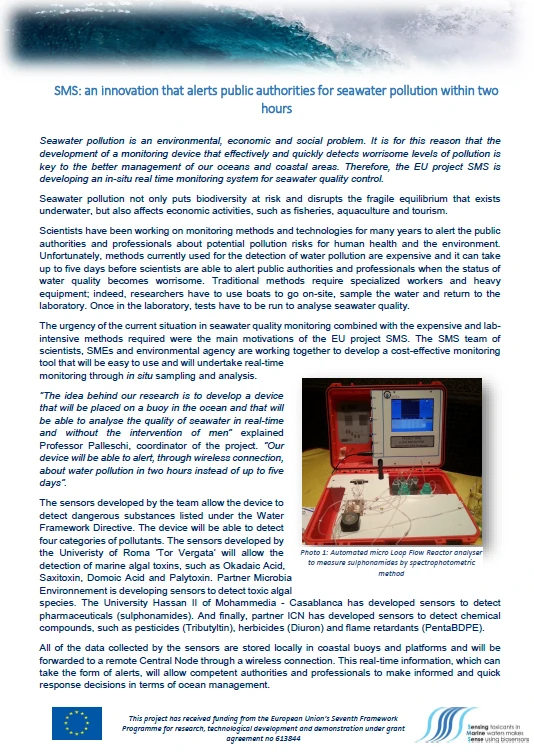
The following media talked about our project ! Click on the image to read their article.
FISH INFORMATION & SERVICES 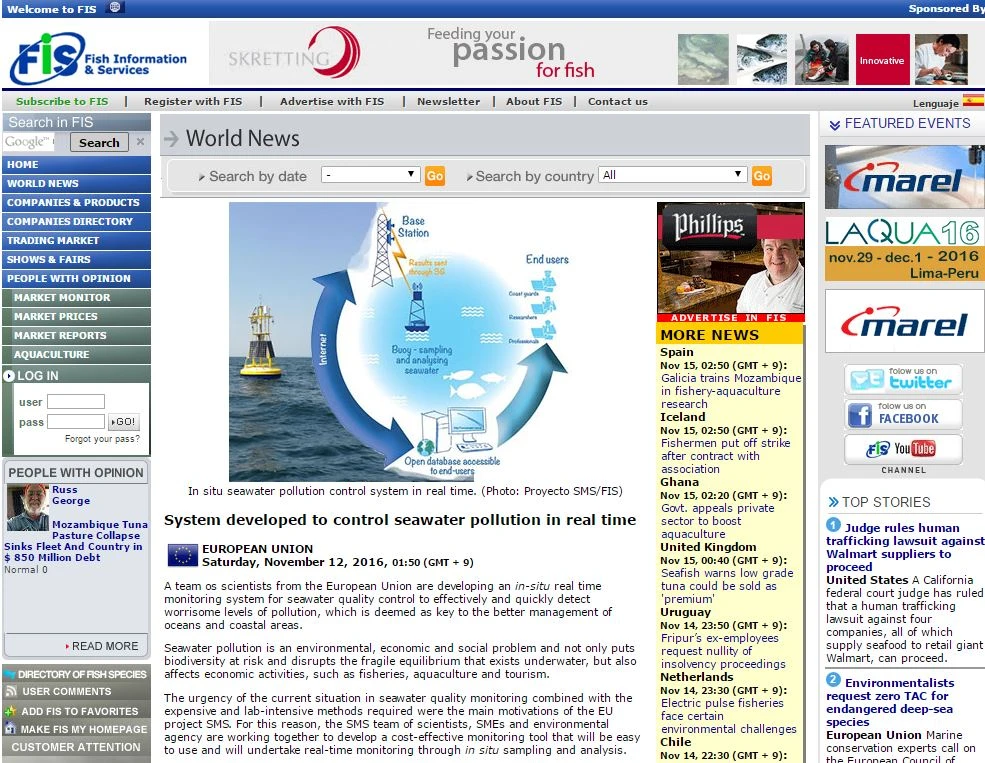
CORDIS 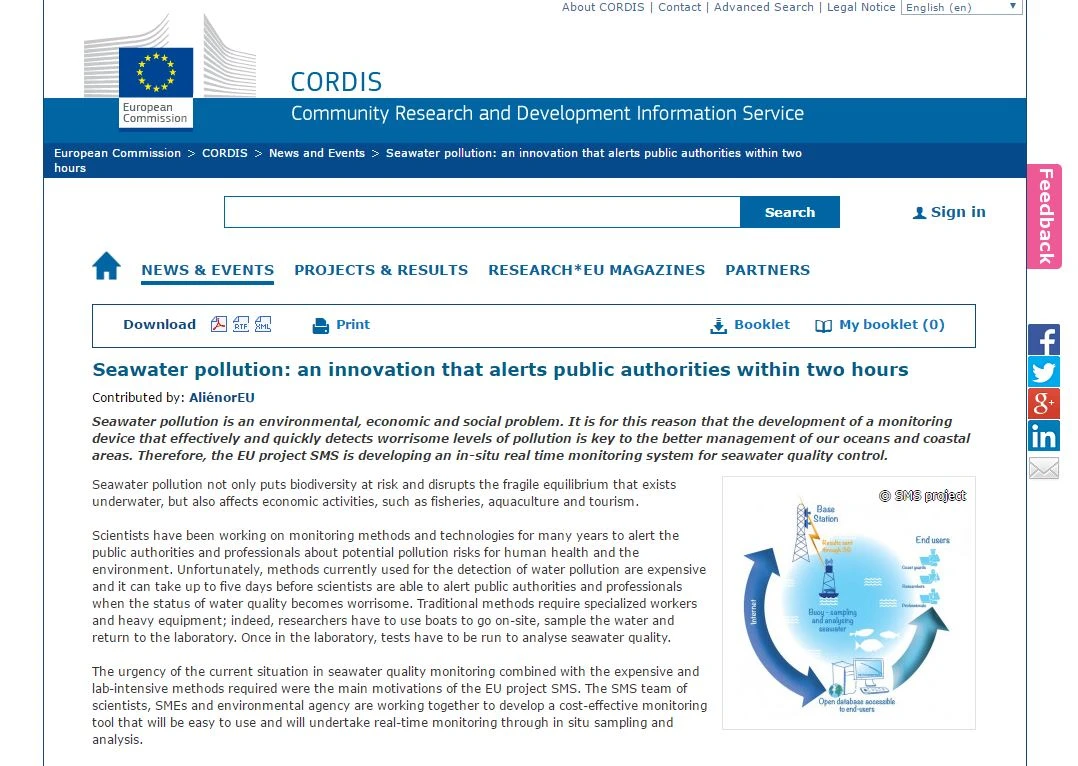

Click on the Newsletter to open it!
Edition #1 
Edition #2 
Click here to read our press release
The following media talked about our project ! Click on the image to read their article.
THE FISH SITE 
LA VANGUARDIA 
AFRICAN FISHERIES 
CONTROCAMPUS 
NOTIZIE IN CAMPUS 

Download our poster here !

The project will try to help protect the marine environment while helping industry to make the best use of it (Blue Growth Strategy). How do you balance the (perhaps) conflicting demands of these sectors on the project?
Three SMEs involved in the project are making devices (Microbia, France), instruments and prototypes (Systea, Italy and Acromed, Sweden) to improve the existing instrumentation to monitor emerging marine pollutants in all oceans, including the coastal areas. So in my opinion there is not a conflicting demand because bothresearch groups and SMEs involved in the project are working to solve the same problems. As marine pollution increases, thanks to the use of novel biosensing
technologies, SMEs are helping the “sensorists" to make their devices working in complex matrices, and in real time.
How does this project differ from or expand on previous work?
Basically this project is expanding the previous work by using an improved biosensor developed in a previous project and adapted to work in real time and to monitor toxic algal species. Moreover, SMS will prepare new biosensors based on aptamers that
detect new pollutants in marine waters as biocidal compounds in antifouling paints (marine transport) – Flame Retardants – plastic components, pesticides, marine toxins, and pharmaceuticals as sulphonamide.
[...]
Read the full interview here

Click here to download it
